Subtractive synthesis, Andean identity, and open audio software from Ecuador.
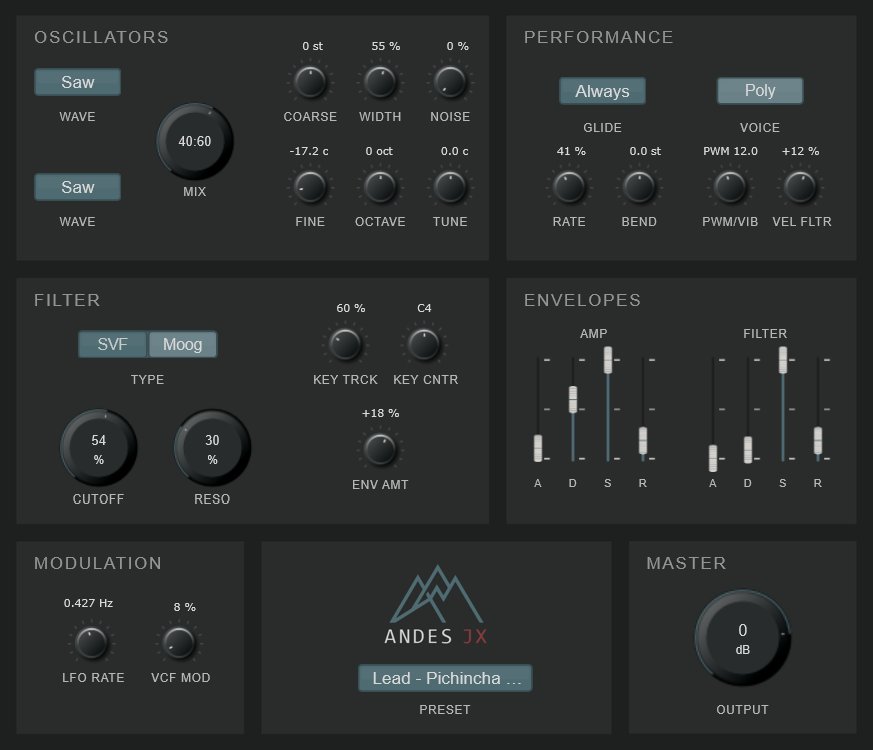
A polysynth from Ecuador
There is no completely neutral place from which to design an instrument. Every synthesizer reflects technical decisions, visual references, and listening habits shaped by the people and environments behind it.
Instruments created in the United States, Europe, and Japan shaped much of the vocabulary of modern subtractive synthesis. Andes JX builds on that legacy while articulating it from a different territory: Quito, Ecuador.
Andes JX is an open-source polyphonic subtractive synthesizer developed in C++ with the JUCE framework. It was conceived as a musical instrument, an open software project, and a platform for studying digital signal processing and audio software architecture.
In 2026, Andes JX was presented at AES LAC 2026 in Lima, Peru, as part of the convention’s technical program.
The project does not attempt to invent a new synthesis paradigm. Instead, it asks what happens when a familiar architecture is designed from a different geography, visual memory, and cultural perspective.
A familiar architecture from a different place
From a technical perspective, Andes JX uses the fundamental building blocks of subtractive synthesis: oscillators that generate harmonically rich signals, filters that reshape their spectrum, envelopes that control their evolution over time, and a low-frequency oscillator for modulation.
In addition, the instrument includes two oscillators with PolyBLEP-based aliasing reduction, independent amplitude and filter envelopes, global LFO modulation, multiple polyphony modes, glide, keyboard tracking, velocity sensitivity, and MIDI control.
One of its most significant sonic decisions is the inclusion of two switchable filter models.
The first is a State Variable Filter based on a topology-preserving structure. It provides a stable and controlled response while supporting several filtering modes within a flexible architecture.
By contrast, the nonlinear Moog Ladder filter introduces stronger saturation and a more pronounced resonant character.
Together, these two filters reflect one of the instrument’s central design principles: keep the architecture focused, but ensure that each decision produces an audible result. Andes JX does not aim to provide unlimited modules or endless modulation routing. Instead, its interface offers a deliberate set of controls, each with a clearly defined role.
Andean geography as identity
The Andean identity of Andes JX is not intended to reproduce Ecuadorian traditional music literally or to translate a landscape directly into sound. Instead, it appears through visual, conceptual, and sonic decisions that place the instrument within a specific territory.
Visual language
The interface uses a slate-blue palette, soft off-white text, and a restrained composition inspired by stone, mist, sky, and the high-altitude landscapes of the Ecuadorian Andes.
Rather than relying on bright accent colors or a futuristic aesthetic, the instrument adopts a contained visual language intended to suggest openness, stability, and the severity of mountain environments.
Factory presets
The 33 factory presets are named after real locations in the Ecuadorian Andes, combined with musical or timbral references.
Examples include:
- Cotopaxi Acid;
- Cayambe 5th;
- Imbabura Pedal;
- Quilotoa Aqua;
- Páramo Sostenuto.
These names propose associations between geography and sonic character. They are not intended as literal representations of each place. Instead, the names, landscapes, and cultural associations provide starting points for sound design.
The bank retains familiar subtractive-synthesis categories such as basses, pads, leads, brass, keys, plucks, and effects. However, it presents them through an identity connected to Ecuadorian geography.
An open educational project
Andes JX was not developed only as a production tool. It was also designed to show how a complete polyphonic synthesizer is organized internally.
The source code is available under the GNU GPL v3 license, together with bilingual documentation in English and Spanish. Its architecture separates the main responsibilities of the system:
- DSP processing;
- plugin, parameter, and MIDI management;
- preset handling;
- graphical interface;
- host integration.
This separation allows individual modules to be studied independently while also showing how they interact within a real-time audio application.
Technical and academic references accompany the PolyBLEP oscillators, Moog Ladder filter, and State Variable Filter implementations. In this way, a student or developer can begin with the source code, consult the original publications, and follow the path from a mathematical concept to its application within a functional instrument.
The project does not claim to present the only correct synthesizer architecture. Its educational value lies in offering a complete implementation that can be read, tested, questioned, and modified.
The JX lineage
The name Andes JX acknowledges two lines of influence.
The first comes from the Roland JX family of polyphonic synthesizers, known for their subtractive architecture and their association with the analog instruments of the 1980s.
The second belongs to open and educational software.
Andes JX grew from the study of JX11, the educational synthesizer developed in JUCE by Matthijs Hollemans for Creating Synthesizer Plug-Ins with C++ and JUCE. JX11, in turn, is related to MDA JX10, the freeware synthesizer created by Paul Kellett and later released as open-source software.
Andes JX continues that lineage while expanding the architecture, documentation, visual identity, and academic purpose of the project.
The term “JX” therefore acknowledges its technical ancestry, while “Andes” defines the place from which that lineage continues.
From NoiseRoomUIO to AES LAC 2026
Andes JX is part of the NoiseRoom UIO project catalog, alongside Classic Compressor CCMkI and NoiseRverb.
Although each plugin addresses a different technical problem, all three share a common intention: combining audio software development with an identity connected to the context in which the projects were created.
NoiseRverb used impulse responses captured in architectural spaces in Quito. Andes JX extends that search into synthesis and virtual instrument design.
The development of the synthesizer also led to the academic paper:
“Design and Architecture of a Polyphonic Subtractive Synthesizer as a Modular Structure for Teaching DSP and Audio Software.”
The paper was selected by the AES LAC 2026 review committee and presented at the convention in Lima, Peru. It examines how a functional synthesizer can serve as an object of study for teaching digital signal processing and audio software engineering.
Presenting Andes JX at AES LAC 2026 provided an opportunity to share work developed in Ecuador with a Latin American community of researchers, educators, engineers, and audio developers.
Try Andes JX
You can download Andes JX as a VST3 plugin for Windows.
The project includes:
- 33 factory presets;
- C++ source code;
- a bilingual user manual;
- technical documentation in English and Spanish;
- a modular architecture built with JUCE;
- GNU GPL v3 licensing.
You can download the instrument, explore the source code, and review the documentation through the following links:
Download Andes JX
GitHub repository
User manual
Andes JX is an Andean synthesizer built in Ecuador, inspired by the Andes, and designed to be heard, studied, and transformed.
Development: NoiseRoomUIO, Quito, Ecuador
Authors: Jhonatan López and Valeria Villarreal
Academic context: work developed in connection with the Numerical Simulation and Computational Analysis Laboratory at Escuela Politécnica Nacional
Wow! Beautiful in every way – sounds, UI, code, mission 🙂