Design, screen printing, and limited production of a T-shirt conceived as the physical extension of an audio software project.
Andes JX as a Metaproduct
The Andes JX T-shirt originated as a physical extension of Andes JX, an open-source polyphonic subtractive synthesizer developed under NoiseRoom UIO. Its usual form is digital: algorithms written in C++, a graphical interface, presets, technical documentation, and a repository from which anyone can study, download, and modify the instrument.
But a project is not defined solely by what it does. Over time, it also develops a visual language, an identity, and a particular way of relating to the people who use it.
This led to a question: what happens when a synthesizer temporarily leaves the screen and becomes a physical object?
The answer was to design a T-shirt that would not function simply as promotional merchandise, but as an extension of the project itself—an object capable of preserving part of its visual language, its origin, and its connection to the original software.
In that sense, the T-shirt can be understood as a metaproduct: it does not replace the synthesizer, but expands its universe through another object.
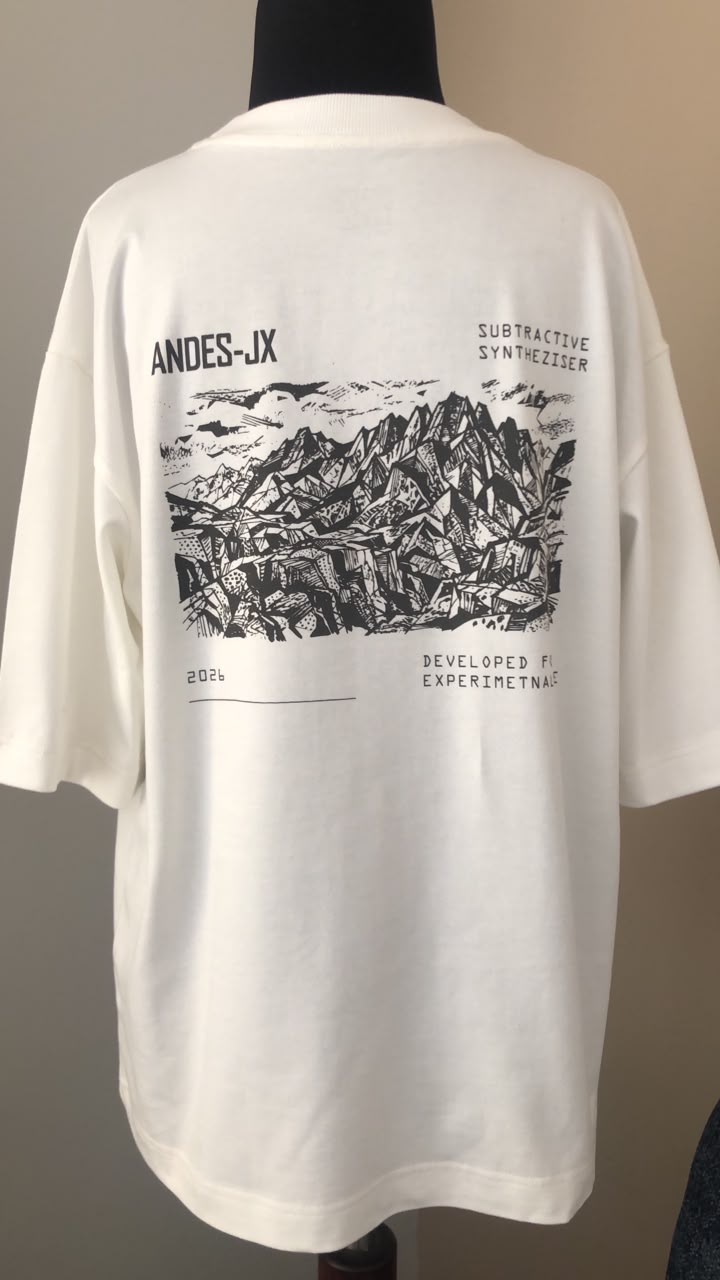
Andes JX T-shirt, limited edition of 12 units, featuring an original illustration inspired by the Ecuadorian Andes and manually screen-printed graphics.
Translating the Andes onto a Textile Surface
The identity of Andes JX has always been connected to the place where it was conceived. Its name, interface, and visual language emerge from a specific intention: to develop audio technology from Ecuador without attempting to conceal that origin.
The T-shirt continues that idea.
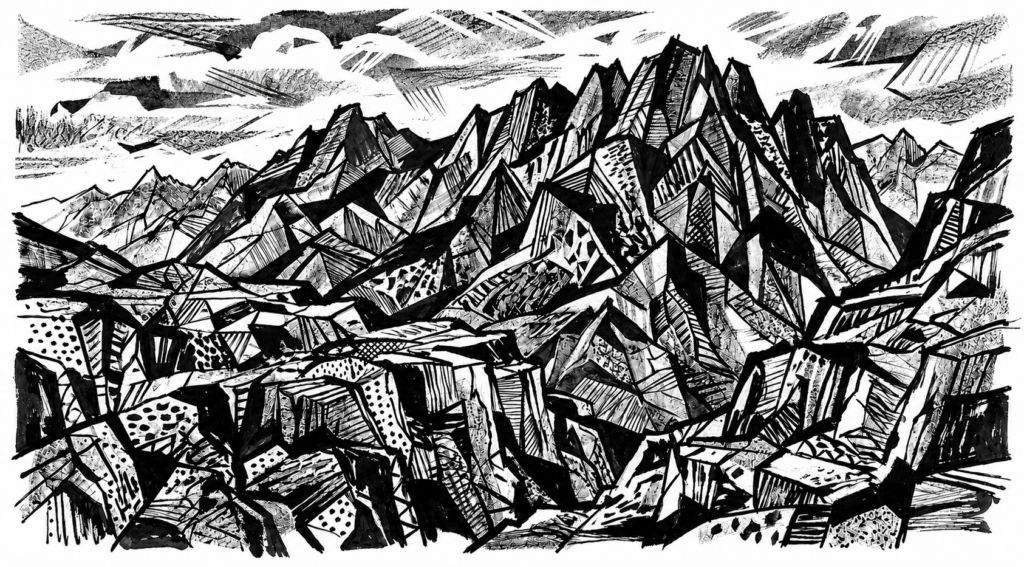
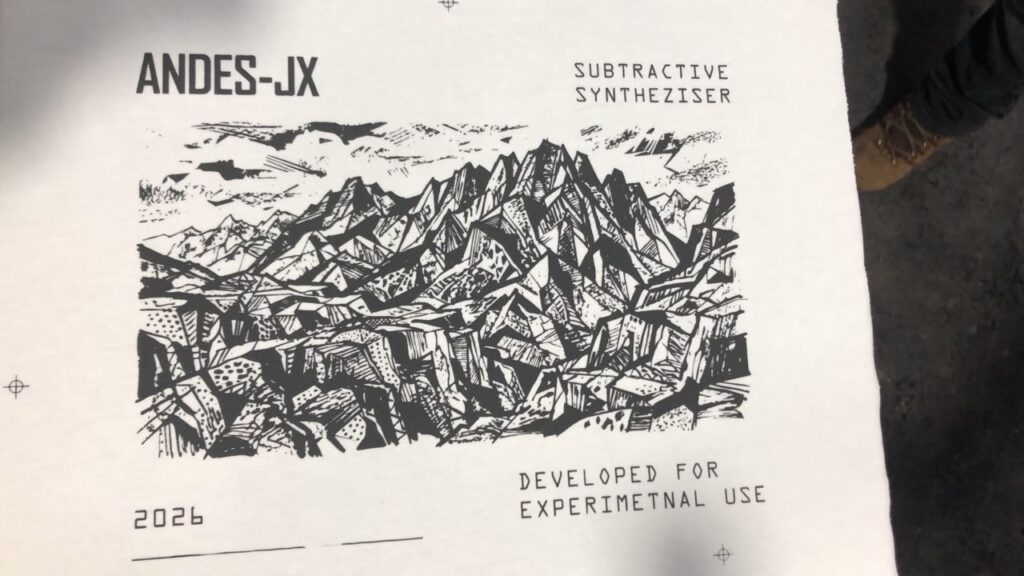
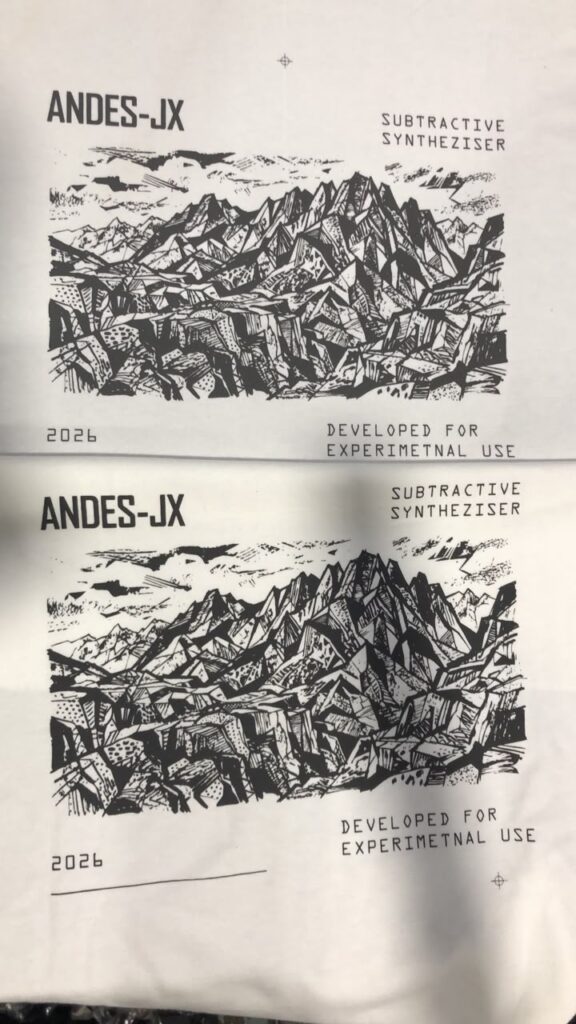
The main graphic on the back is an illustration I created as an interpretation of the Ecuadorian Andes. It does not depict a specific mountain, nor does it attempt to construct a realistic landscape. It is composed of fractured planes, lines, textures, and areas of high contrast that fragment the territory until it becomes a graphic structure.
The composition draws from gestural drawing, Latin American modernism, and certain elements of Synthetic Cubism, but it was conceived from the beginning to coexist with the technical language of Andes JX.
The landscape therefore ceases to function solely as a landscape. It can also be read as a signal, a spectrum, a structure, or even an abstract representation of information.
A Graphic System Connected to the Synthesizer
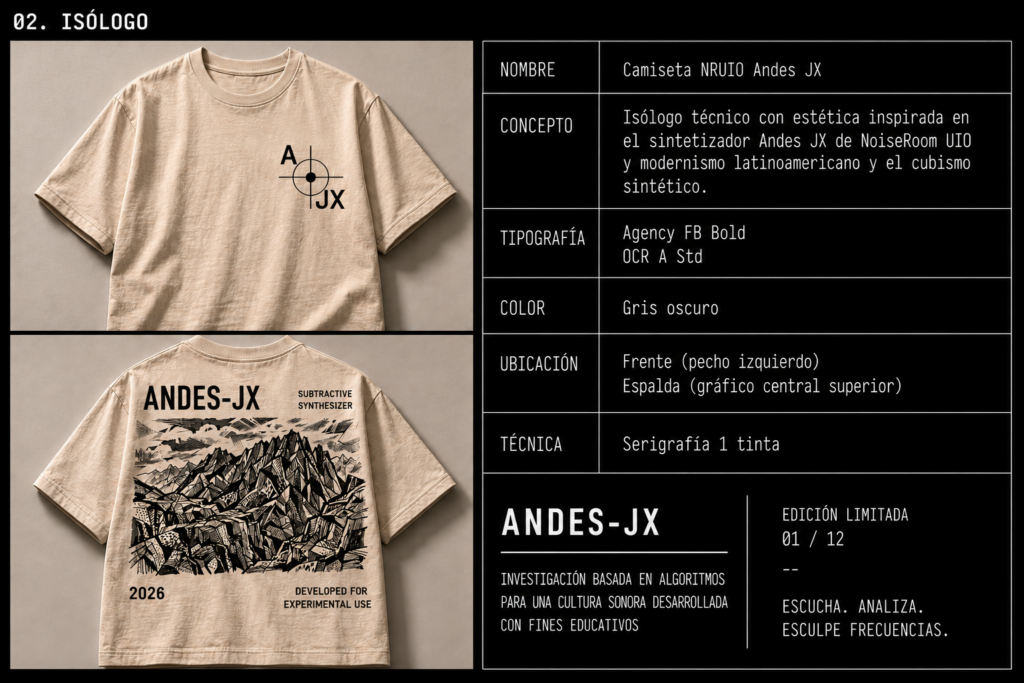
The front uses a reduced version of the Andes JX visual system.
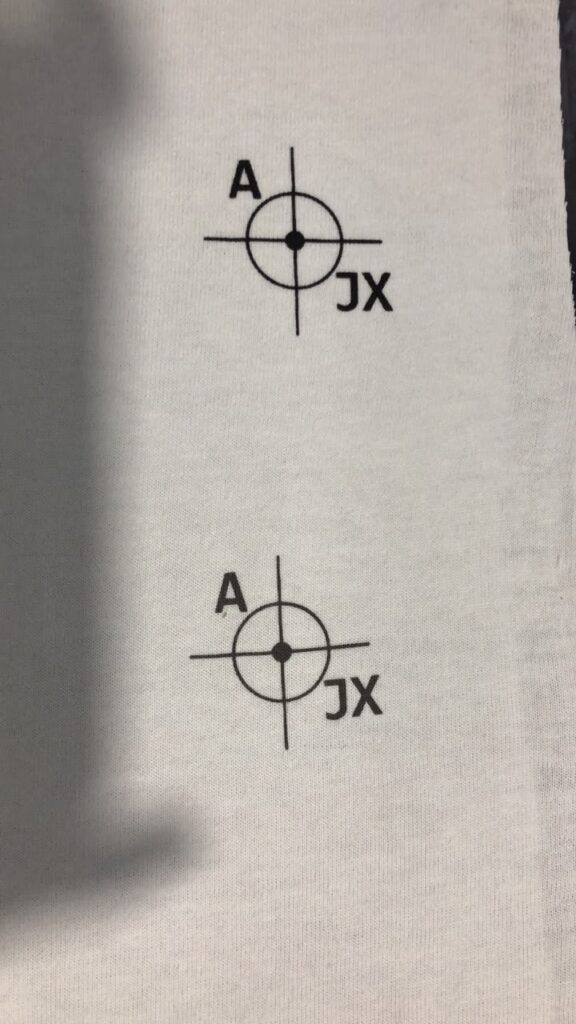
The letters A and JX are arranged around a circle crossed by two axes. The figure can simultaneously be read as a coordinate, a measurement point, an interface control, or a geographical reference.
The central point also refers to a recurring idea within NoiseRoom UIO: creating technology from latitude zero. The symbol therefore acts as an indirect reference to Ecuador and the Equator without resorting to a literal representation.
The back also includes the name ANDES-JX, the description SUBTRACTIVE SYNTHESIZER, the year of production, and the phrase DEVELOPED FOR EXPERIMENTAL USE.
The intention was to bring the garment closer to the visual language of an instrument, prototype, or laboratory object than to that of a conventional promotional T-shirt.
Designing Also Means Discarding
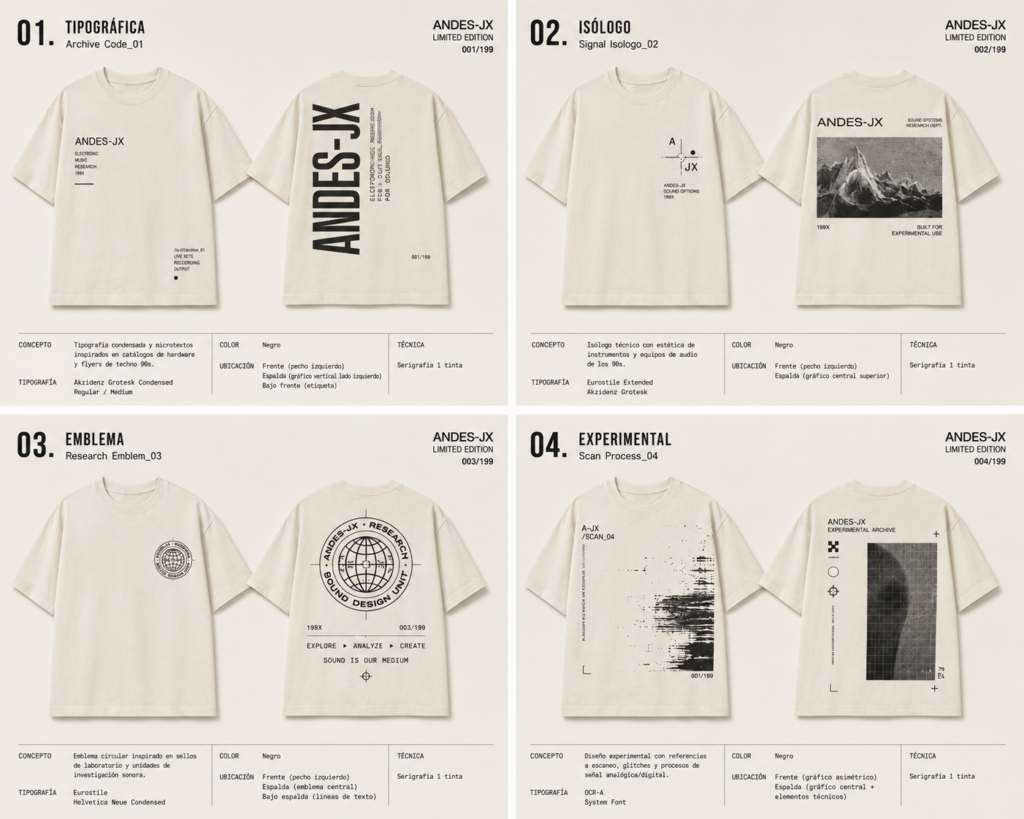
Several versions existed before reaching the final result.
The first proposals explored four directions: one based primarily on typography, another on the logomark, a third closer to laboratory stamps and identification marks, and a fourth built around experimental-looking graphics.
The final version ultimately incorporated elements from several of them.
The logomark survived almost unchanged. The mountain illustration became the center of the back composition. Part of the typographic language and the small technical annotations came from the other explorations.
But moving a proposal from a screen onto an actual T-shirt introduced a new set of constraints.
A line that works at 100% zoom may disappear on cotton. A composition that looks balanced in a mockup may appear too small when placed on an actual back. And an illustration containing too much information may become a dark mass when transferred through a screen-printing matrix.
That is why prototyping was necessary.
From a Complex Illustration to a Single Ink
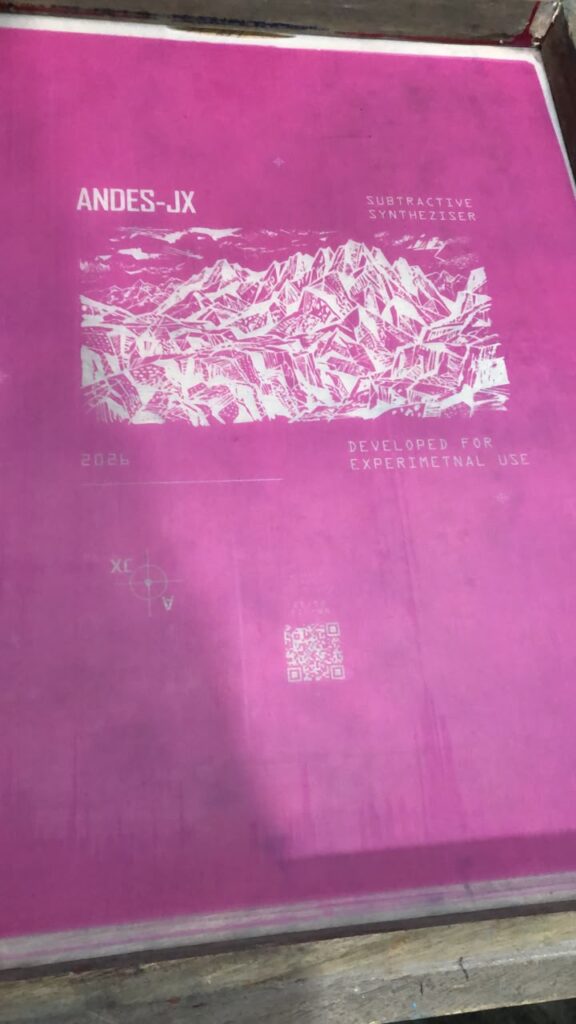
The original illustration contains a considerable number of lines, patterns, and variations in density. To screen-print it, the amount of information had to be reduced and decisions had to be made about which elements needed to survive the printing process.
The goal was not to reproduce the original artwork with absolute fidelity.
It was to find a second version of the image that would work specifically on fabric.
The black masses needed to retain enough visual weight. Fine lines had to remain visible. Textures could not close up completely, and the negative spaces still needed to function as part of the composition.
This process slightly changed the nature of the artwork: an image originally developed as an illustration also became a reproducible printing matrix.
Material, Fabric Weight, and Presence
The twelve T-shirts were made from 100% cotton, with an approximate fabric weight of 255 g/m².
The choice was primarily based on the desired physical presence and use of the garment.
Rather than producing a lightweight promotional T-shirt, we wanted a garment with more structure, capable of supporting a large back graphic while maintaining a defined silhouette.
Fabric weight alone does not guarantee that a garment will be more durable. Its lifespan also depends on the quality of the fabric, construction, seams, manufacturing process, washing, and subsequent care. For that reason, I prefer not to present the choice of cotton as a guarantee of sustainability.
Its relationship with slow fashion lies instead in the way it was produced: a small run, local manufacturing, close attention to the process, and the intention to develop an object capable of retaining value beyond a campaign or a season.
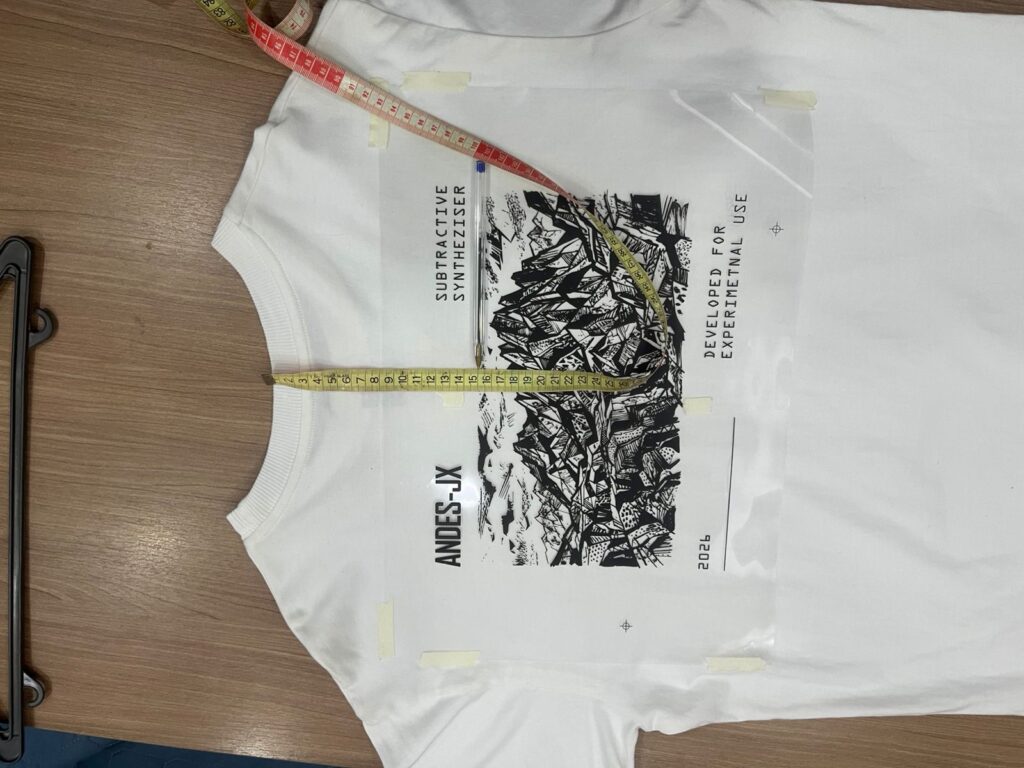
From Digital Layouts to Real Measurements
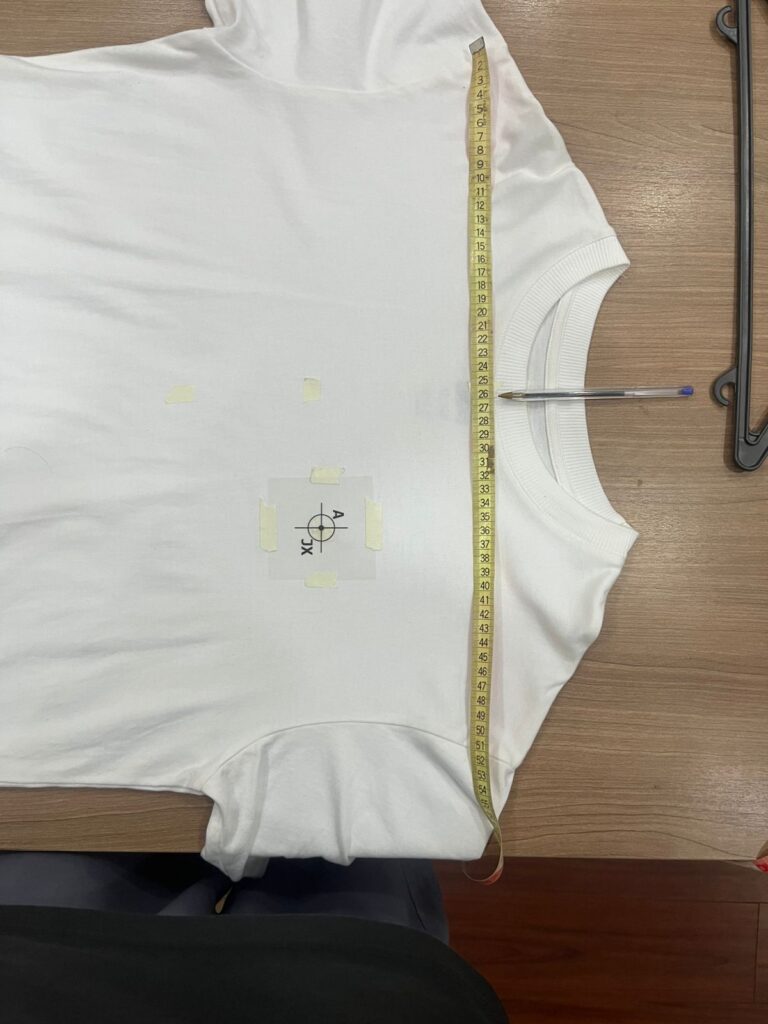
Una parte particularmente interesante del proceso fue comprobar que diseñar sobre una plantilla no es lo mismo que trabajar sobre una prenda.
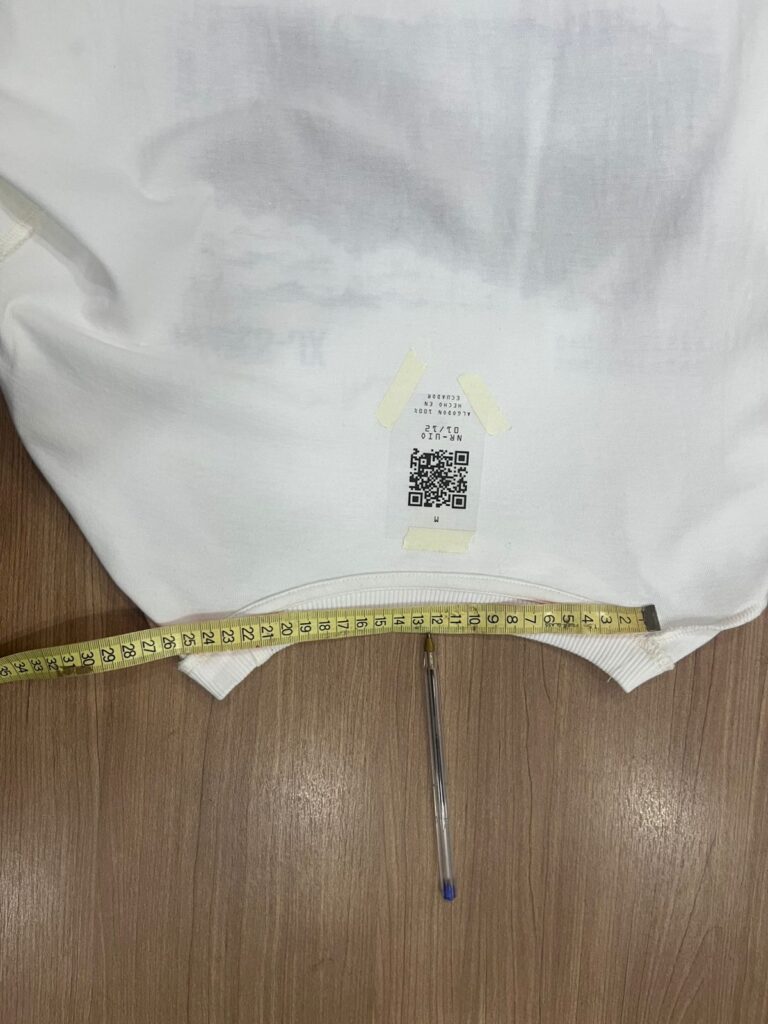
Antes de imprimir fue necesario posicionar físicamente los artes, verificar distancias respecto al cuello, determinar la altura del gráfico posterior y comprobar las proporciones del isólogo frontal.
La camiseta se convirtió literalmente en otra superficie de prototipado.
Manual Screen Printing
The first production run was manually printed by screen printer Diego Panamá.
Black and white textile pigments and a printing base supplied by Alemena de Serigrafía were used specifically for testing and producing the garments.
The pigments provide the color, while the printing base acts as the medium used to prepare the mixture for printing. The chemical formulation of these materials was not analyzed as part of the project, so it is more accurate to describe them in terms of their function and the results obtained rather than attribute environmental properties that have not been verified.
The final print uses a single ink.
The choice of a water-based system was primarily driven by the finish we were looking for: a lightweight print with minimal surface presence that would integrate more naturally with the cotton.
This type of result is sometimes commercially described as a no-hand or zero-hand feel. The term refers to the tactile finish rather than to a different printing technique: the process remains manual textile screen printing.
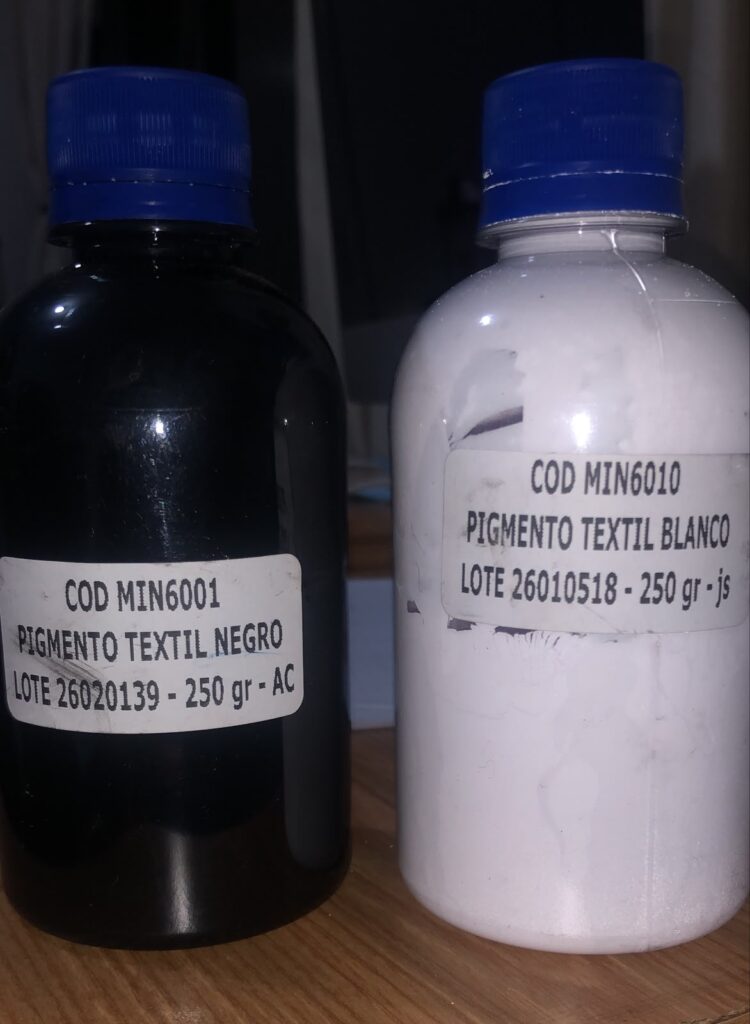
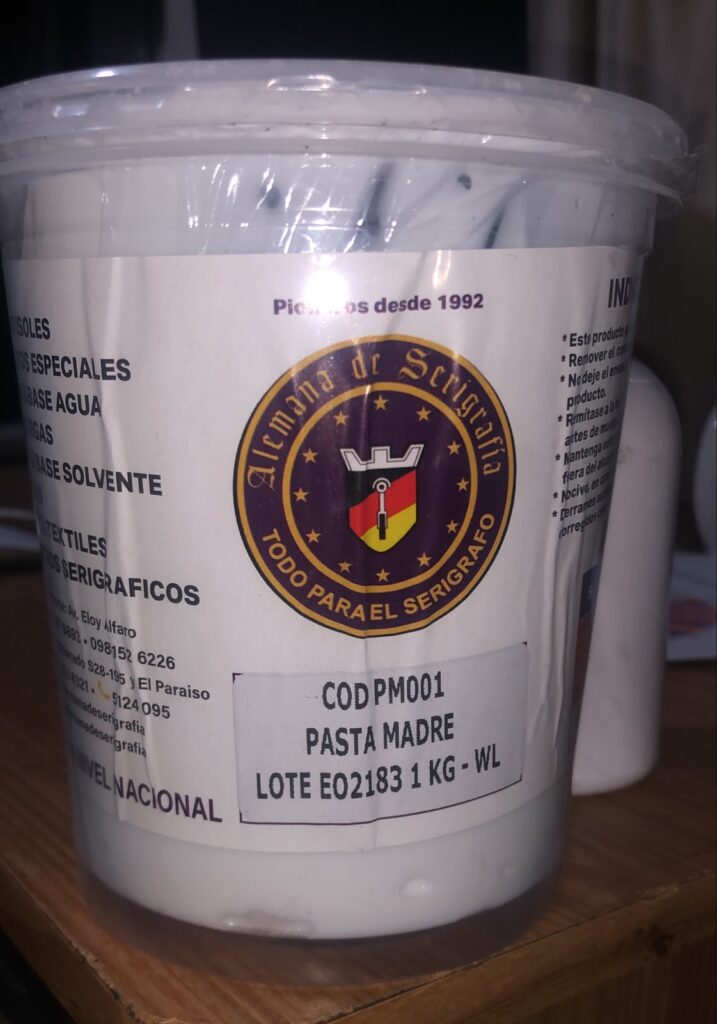
Pigmentos textiles y pasta madre utilizados durante el desarrollo de la impresión. Los materiales fueron suministrados para preparar las mezclas utilizadas en las pruebas y en la producción definitiva.
A QR Code as a Link to the Source Code
The T-shirt was not meant to represent Andes JX only visually.
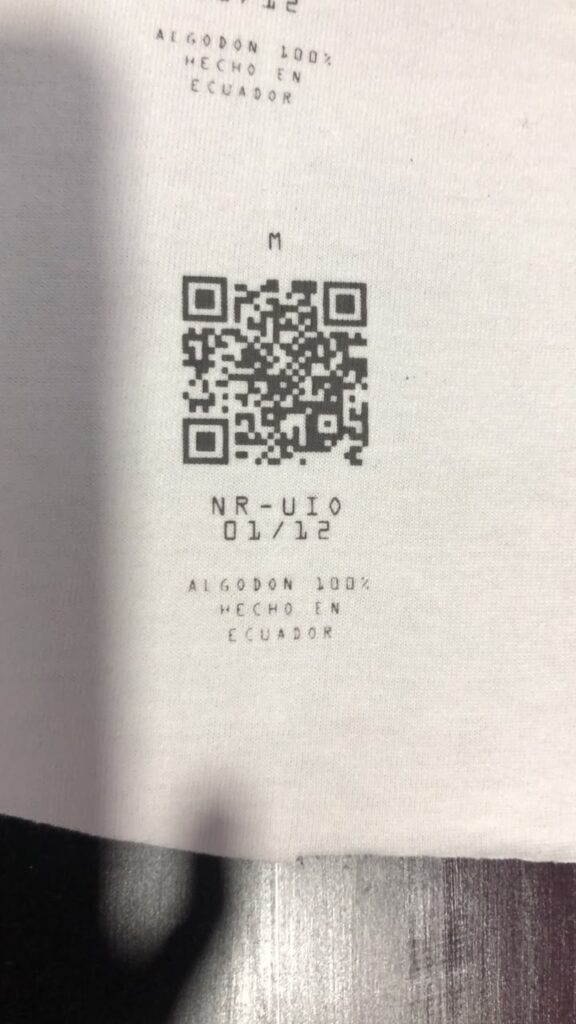
A QR code was added to the back of the neck, linking directly to the project’s repository.
This creates a functional connection between the physical object and the software. Scanning it takes the user back to the place where Andes JX actually exists: its source code, documentation, and project files.
The QR code also introduced a technical challenge.
Unlike an illustration, where a small loss of information may remain visually acceptable, a code must preserve enough definition and contrast for a camera to interpret it correctly.
Specific scale and printing tests were therefore carried out before incorporating it into the final garments.
The Andes JX T-Shirt as a Limited Edition
The first edition of the Andes JX T-shirt consists of twelve units.
The quantity was not chosen to artificially create a sense of scarcity. It primarily reflects the scale of the project.
Producing a small first run made it possible to work closely with pattern making and garment construction, review dimensions, carry out screen-printing tests, and avoid manufacturing a substantial inventory before understanding how people would respond to the object.
All garments from this first series carry the mark:
01/12
In this case, the inscription does not function as an individual serial number for each T-shirt, but rather as an identifier of the first edition, consisting of twelve units.
Much like a software version, this first edition represents a particular moment in the development of Andes JX. A future interpretation of the project would not necessarily need to reproduce this object exactly.
During production of this first run, a typographical error was also found in one of the garment inscriptions: “EXPERIMETNAL USE” instead of “EXPERIMENTAL USE.” Rather than discarding the series, the decision was made to preserve it as part of the material record of the process.
In this sense, the first run can also be understood as a prototype edition: an edition that retains concrete traces of its initial production stage and documents the process of taking Andes JX from software to a physical object.
And that is precisely part of the idea.
Local Production
The T-shirt brings together different forms of work.
The concept, visual direction, illustration of the Andes, logomark, and final artwork were developed by me as part of Andes JX and NoiseRoom UIO. I also defined the dimensions and placement of the graphic elements and supplied the materials used during the printing tests.
Pamela Males was responsible for producing the twelve garments and collaborated in production coordination, particularly in finding and communicating with the professional responsible for the screen printing.
The printing was carried out manually by Diego Panamá, who translated the digital files into a physical process and resolved their application onto the fabric.
This division of tasks matters.
The result does not come solely from graphic design, garment construction, or printing. It exists because different forms of knowledge had to converge around the same object.
A Project You Can Also Wear
The T-shirt does not replace Andes JX.
Nor does it attempt to summarize the entire project in a single illustration.
It is an extension.
The mountains refer to the territory from which the project was developed. The logomark connects geography, technology, and visual language. Screen printing makes a manual process visible. The numbering records the first production run, and the QR code ultimately leads the user back to the software.
Through NoiseRoom UIO, I am interested in allowing projects to exist in more than one form.
Andes JX can be heard.
It can be studied.
It can be modified.
Its source code can be opened and taken apart to understand how a synthesizer works.
And, for at least these twelve units, it can also be worn.
Availability
The first Andes JX Prototype Edition is available as a limited run of 12 units.
Price: USD 27
Purchases are currently handled directly through NoiseRoom UIO via Instagram DM.
Technical Specifications
| Item | Specification |
|---|---|
| Project | Andes JX |
| Label / platform | NoiseRoom UIO |
| Edition | 01/12 — First edition |
| Series size | 12 units |
| Edition identification | All garments carry the 01/12 mark |
| Classification | Prototype Edition |
| Material | 100% cotton |
| Fabric weight | Approx. 255 g/m² |
| Printing | Manual textile screen printing |
| Number of inks | 1 |
| Printing system | Water-based |
| Materials | Textile pigments + printing base |
| Materials supplier | Alemena de Serigrafía |
| Item | Specification |
| Concept and visual direction | Jhonatan López / Fabian Jácome |
| Illustration | Jhonatan López / Fabian Jácome |
| Design and final artwork | Jhonatan López |
| Pattern making | Pamela Males |
| Garment construction coordination | Pamela Males |
| Production coordination | Jhonatan López / Pamela Males |
| Screen printing | Diego Panamá |
| Design origin | Quito, Ecuador |
| Handcrafted production | Ibarra, Ecuador |
| Digital connection | QR code linking to the Andes JX repository |
| Edition note | This first run retains the “EXPERIMETNAL USE” inscription as a material record of the production process |